Written by: WSCL Marketing Team
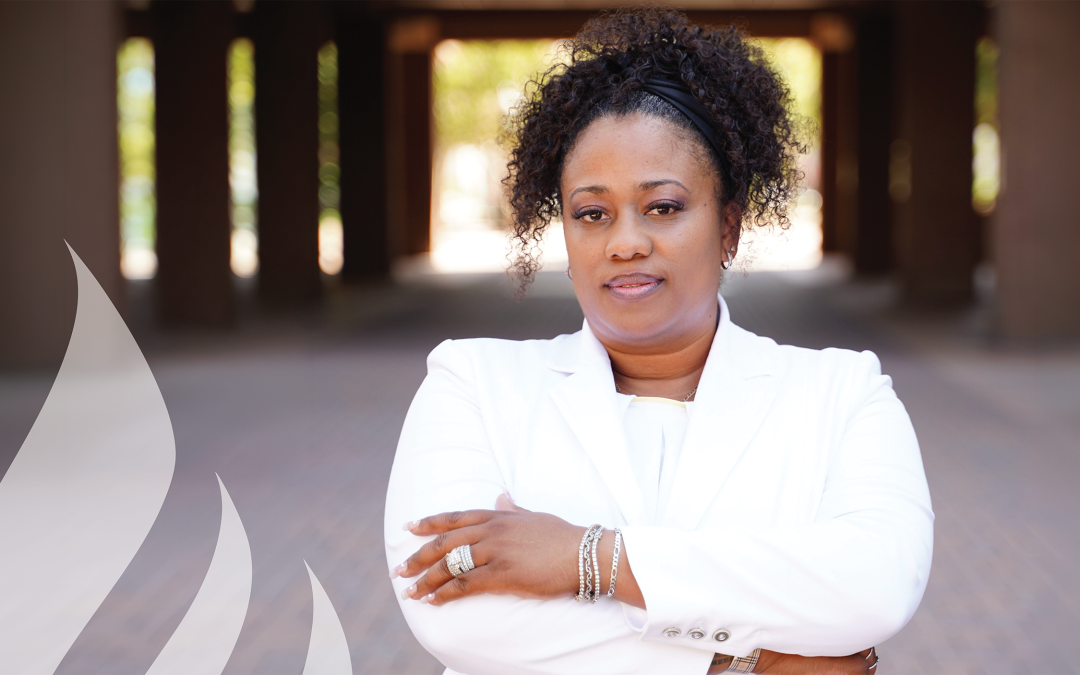
Royal DL Bond, a Western State College of Law alumna from the Class of 2021, didn’t take the traditional path to the legal profession. Her journey took her through several different careers before she started law school. Today, she is a nationally recognized trial attorney and has founded Bond Law, her own law firm. Her story exemplifies a journey of personal challenges and triumphs, and shows how determination, resilience, and the right legal education can transform dreams into reality.
Now a trial lawyer in criminal defense, civil rights, and personal injury law, Royal has been named among the Top 100 by National Trial Lawyers and the National Black Lawyers Top 100. “I will tell you, it’s very humbling,” she says of the recognition. “It’s a humbling validation that recognizes the hard work we put in that we think goes unrecognized.” Yet, when she thinks about her career, it’s not just the awards that are important to her. What matters far more to Royal is her impact on her clients. “None of that compares to the letters that I get from the clients,” she says.
Her story is a story about perseverance, finding her purpose, and the practical training that helped her evolve into the fierce advocate she has become today.
A “Late Bloomer” In The Legal Field
Royal knew she wanted to be a lawyer from childhood. But, like many aspiring attorneys, she used to believe that the legal path was out of reach for her. “I’ve always wanted to be a lawyer,” she says. “I thought it was unattainable, so I put it off for a while.” She went through multiple careers before finally realizing that law was what she wanted to do all along. “I’m a late bloomer,” she asserts.
Before law school, Royal worked in cosmetology, served in the military, became a budget analyst in civil service, and even stepped into the entertainment industry, where she ran a record label and managed artists. Eventually, though, her drive toward the law became too strong to ignore. “I believe that your gift makes room for you,” she says with a smile. “And I know that this is what I’m supposed to do.”
Her drive toward the law stemmed from a desire to be heard, and to help others be heard as well. “It was definitely me wanting to be understood,” she explains. “That’s what always caused me to advocate, not just for myself, but for those who look like me. I learned quickly that it wasn’t just me who was misunderstood. But it’s a lot of people that look like me that were also misunderstood.” Today, that same drive shapes her work in criminal defense and civil rights, where each one of her cases carries real, personal stakes for the people she represents.
From Personal Drive to National Recognition
Royal’s dedication to her clients and craft has earned her national recognition. She attributes the accolades to the effort she puts in behind the scenes. “A lot of times, people don’t know that you’re up till 2:00 trying to make sure that you have the facts of your case,” she says. “Those validations just go to show that your hard work pays off.”
Still, the moments that matter most to her are much more personal. “None of that compares to the tears that I see roll down their faces sometimes from simple conversations,” she says as she describes moments with her clients. “We haven’t even gone to trial, but for them, it’s like the lights are coming on, and change is happening in that moment.”
For Royal, success is about more than recognition. It’s about the trust and transformation she builds with her clients. “It’s validation that I’m doing exactly what I’m supposed to do,” she explains.
When Preparation Meets Practice
In the unpredictable world of trial work, where witnesses can change their stories, emotions run high, and judges can make unexpected rulings, Royal has learned the strongest lesson of all: be prepared, and be flexible. “You really have no control over the different variables that can happen in the middle of a hearing,” she says. “You have to be able to roll with the punches.”
Of course, being prepared makes it a lot easier to adapt. In fact, it’s essential. “As long as you know your case and you’ve prepared, you’ll be fine,” she explains. “If you know your facts, anything that happens, you’re able to pivot as you need to.”
She traces that mindset back to her time at Western State, where professors placed a strong focus on hands-on preparation for real-world legal situations. “The program was very rigorous,” she says. “And it prioritized practical application. Practical over theory.”
That emphasis on hands-on preparation, she explains, is what helped her go from understanding legal theory to applying it properly and confidently in the courtroom as a trial lawyer. It’s also what prepared her for the unpredictable nature of trial work, where preparation and adaptability are absolutely essential.
A Lesson That Still Guides Her Today
In law school, students spend a lot of time with their professors, who can have a strong impact on them. For Royal, one of the most impactful memories she has came from Professor Charles Sheppard’s Property class, where a simple phrase turned into a lesson she carries with her till this day. “Whatever answer was given, sometimes his response would be, ‘That’s not your best answer,’” she recalls.
At the time, his statement was a challenge to think deeper. But now, it’s become something that persists in the back of her mind when she’s working on a case. “Now I think about that, even when questioning witnesses, even when talking to my clients. Is that the best answer? Is that the best strategy?”
The lesson stuck with her because that’s exactly how the law works: outcomes depend on many variables, and the best lawyers are the ones who look at things from all angles. “A lot of times, an attorney’s answer would be, ‘It depends,’” she says. “So I’m constantly reminded of Professor Sheppard’s words: ‘That’s not your best answer.’ And that’s what I draw from.”
The Importance of Learning from Practicing Attorneys
Royal also valued Western State’s emphasis on instruction from working attorneys. Adjunct professors who were actively practicing law brought real-world examples into the classroom, helping bridge the gap between theory and practice. “I appreciated the examples that they were able to provide,” she says. “That real world experience was able to bridge that gap between the classroom and the courtroom.”
That perspective helped her understand something many students only realize later: “Law school teaches you how to think; it doesn’t teach you how to practice law.” For her, the real-world examples and analogies often shared by adjunct professors with active careers in the legal field are what helped her make the leap from student to trial lawyer. They helped her connect those dots early.
The Importance of Representation
As a Black woman in the legal profession, Royal feels very strongly about the impact of representation and the importance of reputation. “Representation matters deeply,” she says. “Your representation is everything.”
She hopes her success sends a message to other women of color considering law: their voices and experiences are very powerful. “I hope to show other women of color that their perspective is a superpower,” she says.
She also speaks openly about the extra pressure many Black women face in professional spaces, where perception can influence their careers as well as their clients’ outcomes “We have to think about who we are representing,” she explains. “Whatever we do, our actions don’t just reflect on us. They reflect on the client.” That reality shapes how she carries herself in the courtroom, and why she puts so much emphasis on professionalism and integrity.
Giving Back to the Next Generation of Lawyers
Royal sees her success as a responsibility to help others succeed. She says it best: “Success is hollow if you’re not reaching back and pulling other people up.” It’s a striking statement that she follows through on by regularly meeting with law students and offering advice about the realities of legal practice. Her mentorship focuses less on exam strategies and more on real-world practice, like courtroom dynamics, procedures, and career decisions. “I had to bump my head a couple of times,” she says. “And it’s my desire to keep law students from having to do that.”
Her own career path reflects that bold, independent spirit. “I started my own law firm 30 days after having my bar card,” she says. Now, she hopes to return to Western State to speak with students, particularly through student organizations like BLSA, share her experiences, and help guide the next generation of advocates.
A Proud Western State Alumna
Representing Western State on a national level is something Royal takes seriously. “It is a point of great pride,” she says. “It demonstrates that Western State produces great advocates first and foremost.”
She frequently encounters fellow alumni in the legal community, and those shared connections reinforce her appreciation for her alma mater. At one point, she reflected on the school’s history and legacy. “I had to sit back one day and really put it into perspective,” she says. “I went to the oldest law school in Orange County. That says a lot.”
Royal’s pride in Western State is rooted in the strong attorneys and judges the school has produced. “Western State is definitely a community-focused institution that transforms students into fierce, practice-ready attorneys,” she states.
The Definition of Real Success
Throughout her legal career, Royal has found a recurring theme: integrity, trust, and client relationships matter more than any awards. “It’s great to get all the accolades,” she says. “But none of that matters more than the accolades you get from your clients.”
For her, the most meaningful recognition comes from the community she serves: the referrals, the thank-you calls, the families who trust her name. “It’s that working to ensure that whatever you do, you do it with integrity,” she says. “Whether you win or you lose, you’ve established that trust with your client. You both win.”
Royal DL Bond’s journey, from multiple careers to national recognition, reflects the power of perseverance, purpose, and a legal education grounded in real-world preparation. It’s a story that speaks to her success and demonstrates the kind of advocates Western State continues to produce: resilient, practice-ready, and committed to making a difference.